 Tone. Every horn player worth their salt needs a good – or at least memorable – one (to paraphrase Mark Hollis: before you play two notes, learn how to play one).
And as technique and speed become more and more prevalent in jazz, it’s nice to hear a saxist who sucks out the marrow of each note, and places beauty over style in his list of priorities.
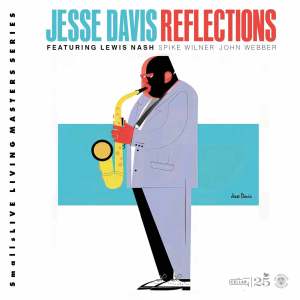
New Orleans-born alto player Jesse Davis’s new album Reflections – his 10th, recorded live at GB’s Juke Joint in Long Island City – sounds like it was documented at a soundcheck because there’s no audience applause.
But the interplay between the four musicians, including special guest drummer Lewis Nash, is very real. Davis been a reliable fixture on the scene for 40 years, initially mentored by Ellis Marsalis and then appearing on albums/tours by Gerald Wilson, Cedar Walton, Milt Jackson, Ray Brown and Clark Terry.
And if you’re looking for an unashamedly bluesy alto hero in the footsteps of Charlie Parker, Cannonball Adderley or Sonny Stitt, you could do a lot worse.
Davis’s own compositions comprise the lion’s share of the album. The catchy tango ‘Blue Autumn’ announces his gorgeous, creamy tone in no uncertain terms.
‘Chocktaw Alley’ – named for the New Orleans street – is an altered blues in 6/8 which apparently takes its initial inspiration from ‘Blue Monk’. Davis’s solo is just wonderful on this.
‘Funk Sugo’ is less successful, with Nash’s backbeat failing to deliver the goods. But medium-slow swinger ‘It’s Just Farewell’ is anything but maudlin, instead a rather jaunty tune replete with major and minor-seventh chords.
There are two takes on Monk: ‘Reflections’ is delicious, though Spike Wilner’s piano accompaniment is sometimes uncertain and seems to miss a few key passing chords (and the piano itself doesn’t sound great. a little out of tune).
Meanwhile ‘Evidence’ kicks off with a Nash solo, a fine little composition in itself, and then evolves with a brave rhythmic reformatting of the famously tricky melody.
There are one or two minor gripes with Reflections – Wilner’s piano occasionally puts a spanner in the works and the arrangements aren’t particularly interesting, perhaps showing a lack of rehearsal.
But overall this is a very warm, enjoyable date and Davis’s luxuriant tone demands as wide an audience as possible.

